Introduction
In the electronics industry, the terms PCB and PCBA are often used interchangeably. However, they refer to two different stages in electronics manufacturing.
Understanding the difference between PCB and PCBA is essential for engineers, product designers, and procurement teams.
What is a PCB
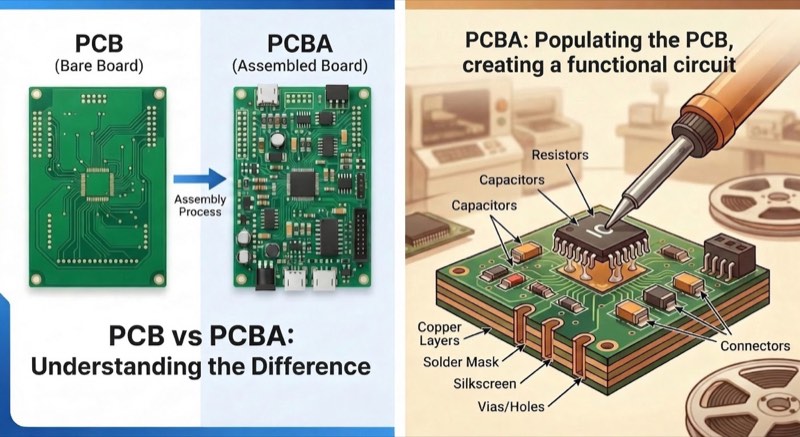
A Printed Circuit Board (PCB) is the structural foundation of electronic devices. It is made of insulating material, usually fiberglass (FR4), with copper traces that connect electronic components.
A PCB by itself does not contain electronic components. It only provides the conductive pathways required for electronic circuits.
Typical PCB elements include:
- copper layers
- solder mask
- silkscreen
- vias and holes
What is PCBA
PCBA (Printed Circuit Board Assembly) refers to the process of assembling electronic components onto the PCB.
Components such as:
- resistors
- capacitors
- integrated circuits
- connectors
are soldered onto the board to create a functional electronic circuit.
PCB vs PCBA Comparison
| PCB | PCBA |
|---|---|
| Bare board | Fully assembled board |
| No components | Components installed |
| Fabrication process | Assembly process |
| Electrical pathways | Functional circuit |
Applications
PCB and PCBA are used in many industries including:
- consumer electronics
- industrial automation
- medical devices
- robotics
- telecommunications
Conclusion
PCB and PCBA represent two essential stages in electronics manufacturing. While PCB provides the physical structure, PCBA transforms it into a functional electronic assembly.
BELI Technologies provides both PCB fabrication and turnkey PCBA services to support customers from prototype to mass production.