
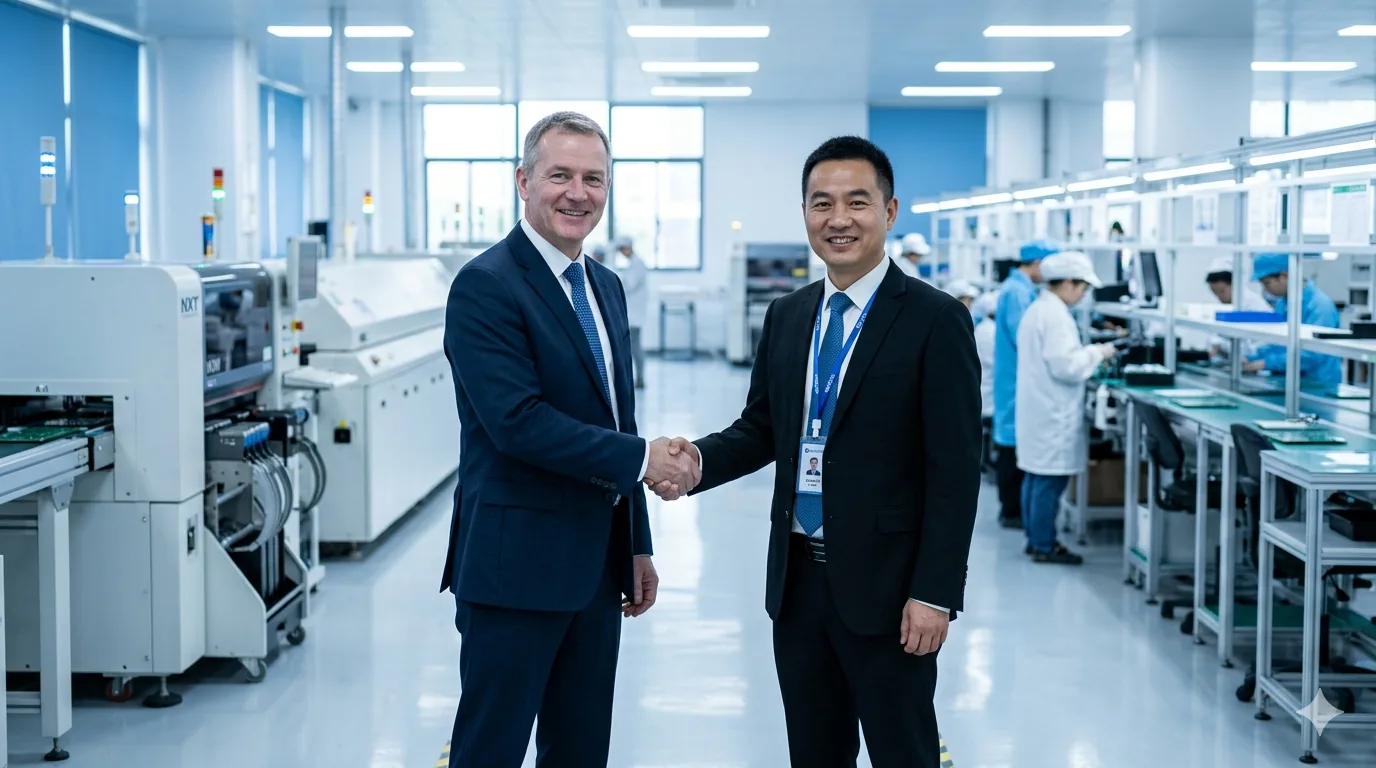
For hardware companies looking to scale production efficiently, partnering with an Electronics Manufacturing Services (EMS) provider in China is one of the most impactful decisions you will make. China remains the world's largest electronics manufacturing hub, offering unmatched supply chain density, competitive labor costs, and deep expertise across virtually every product category.
But not all EMS partners are created equal. Choosing the wrong one can lead to quality failures, communication breakdowns, IP concerns, and costly delays. Choosing the right one can accelerate your time to market, reduce unit costs, and give you a reliable production backbone for years to come.
This guide walks you through the key factors to evaluate when selecting an EMS partner in China — whether you are a startup shipping your first product or an established OEM diversifying your supply chain.
Understand What EMS Actually Covers
Before evaluating partners, it helps to clarify what EMS means in practice. An EMS provider is not just a factory that assembles boards. A full-service EMS partner typically offers:
- PCB fabrication — manufacturing bare printed circuit boards to your specifications
- Component sourcing — procuring electronic parts from authorized distributors or qualified alternates
- SMT and through-hole assembly — populating and soldering components onto the PCB
- Testing and inspection — AOI, X-ray, ICT, functional testing, and burn-in
- Box build and final assembly — enclosure assembly, cable harness integration, and packaging
- Engineering support — DFM review, BOM optimization, and test fixture development
The more of these services your partner can handle under one roof, the fewer coordination gaps you will encounter. A true one-stop EMS partner eliminates the need to manage multiple vendors across different stages of production.
Evaluate Technical Capabilities and Equipment
Not every EMS provider can handle every type of product. Before you engage, assess whether the facility has the right equipment and experience for your specific requirements.
Key questions to ask include:
- What SMT line equipment do they use? High-speed pick-and-place machines from brands like Yamaha, Fuji, or Panasonic indicate serious investment in precision.
- Can they handle fine-pitch components, BGAs, QFNs, and 01005 passives?
- Do they have X-ray inspection capability for hidden solder joints?
- What PCB layer counts and materials can they fabricate? Can they support HDI, flex, or rigid-flex boards?
- Do they offer conformal coating, potting, or other protective processes for harsh-environment products?
At BELI Technologies, our production lines are equipped with advanced Yamaha SMT systems, 3D SPI, AOI, and X-ray inspection — supporting everything from simple 2-layer boards to complex 20+ layer HDI assemblies.
Assess Quality Systems and Certifications
Quality is non-negotiable in electronics manufacturing. A credible EMS partner should hold relevant certifications and demonstrate a mature quality management system.
Look for the following:
- ISO 9001 — the baseline for quality management across all manufacturing
- ISO 13485 — essential if you are building medical devices
- IATF 16949 — required for automotive electronics
- IPC-A-610 — the industry standard for acceptability of electronic assemblies
- RoHS and REACH compliance — mandatory for products sold in the EU and increasingly expected worldwide
- UL certification — important for safety-critical products
Beyond certifications, ask to see their defect tracking process, corrective action procedures, and first-pass yield data. A factory that openly shares quality metrics is one that takes quality seriously.
Prioritize Communication and Responsiveness
This is where many EMS relationships fail — not because of technical capability, but because of poor communication. When your partner is 8,000 miles away and 12 time zones ahead, communication discipline becomes critical.
Here is what to look for:
- Dedicated project manager — you should have a single point of contact who understands your project inside and out, not a rotating support desk.
- English proficiency — your primary contact should be fluent in English, capable of discussing technical details without ambiguity.
- Responsiveness — a good EMS partner should respond to emails within 24 hours, even if just to acknowledge receipt.
- Proactive updates — the best partners do not wait for you to ask. They flag potential issues, share production photos, and keep you informed at every stage.
At BELI Technologies, every client is assigned a dedicated English-speaking project engineer who manages the project from quotation through delivery. We believe clear, proactive communication is the foundation of every successful manufacturing partnership.
Consider Scalability and Flexibility
Your production needs will change over time. A good EMS partner should be able to grow with you — from initial prototypes of 5-10 units, through pilot runs of a few hundred, to volume production of tens of thousands per month.
Evaluate whether the partner can:
- Handle both low-volume, high-mix orders and high-volume production runs
- Ramp production up or down based on your demand forecast
- Store safety stock of critical components to buffer against supply chain disruptions
- Support multiple product lines simultaneously without quality trade-offs
Flexibility also means the willingness to accommodate engineering changes mid-production, manage revision control, and adapt processes as your product evolves. A partner that is rigid on process may be efficient at scale but painful during the iterative early stages of a product lifecycle.
Choosing an EMS partner is not just a procurement decision — it is a strategic one. The right partner becomes an extension of your engineering team, helping you navigate supply chain challenges, optimize your design for manufacturing, and deliver a quality product on time and on budget.
If you are evaluating EMS options in China, BELI Technologies offers a free project review and quotation. We will assess your design files, recommend optimizations, and provide a transparent cost breakdown — so you can make an informed decision with zero obligation.